
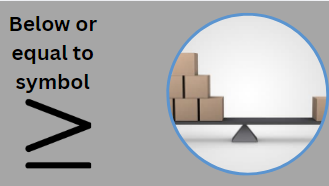
Below or Equal To Symbol (≤): Meaning Uses Examples and Complete Guide
Below or Equal To Symbol (≤): Complete Guide
The below or equal to symbol (≤) is one of the most commonly used mathematical symbols in mathematics statistics science engineering economics and computer programming. It represents a relationship where one value is either less than another value or equal to it.
Understanding the below or equal to symbol is essential for students teachers researchers programmers and anyone working with numerical comparisons. This guide explains the meaning history uses examples keyboard shortcuts and related symbols in detail.
What Is the Below or Equal To Symbol?
The below or equal to symbol is written as:
≤
It means that a number value or expression is either:
- Less than another value or
- Exactly equal to that value
For example:
5 ≤ 10
This statement is true because 5 is less than 10.
Another example:
10 ≤ 10
This statement is also true because both values are equal.
However:
15 ≤ 10
This statement is false because 15 is greater than 10.
Symbol Representation
The below or equal to symbol is:
≤
Unicode Name:
Less-Than or Equal To
Unicode Character:
U+2264
HTML Entity:
≤
HTML Number:
≤
LaTeX:
\leq
Meaning of the Below or Equal To Symbol
The symbol combines two concepts:
- Less Than (<)
- Equal To (=)
Together they form:
≤
This means:
A value can be smaller than another value or exactly the same.
For example:
x ≤ 20
means:
- x can be 20
- x can be 19
- x can be 18
- x can be any number less than 20
Mathematical Definition
In mathematics if:
a ≤ b
then:
- a is less than b OR
- a equals b
This relationship is known as an inequality.
Unlike strict inequalities the boundary value is included.
Examples of the Below or Equal To Symbol
Example 1
3 ≤ 7
True because 3 is less than 7.
Example 2
7 ≤ 7
True because both numbers are equal.
Example 3
12 ≤ 5
False because 12 is greater than 5.
Example 4
x ≤ 100
Possible values:
- 100
- 99
- 50
- 0
- -10
All are valid because they are less than or equal to 100.
Difference Between Less Than and Less Than or Equal To
| Symbol | Meaning | Example |
| < | Less than | 5 < 10 |
| ≤ | Less than or equal to | 5 ≤ 10 |
| > | Greater than | 10 > 5 |
| ≥ | Greater than or equal to | 10 ≥ 5 |
The key difference is inclusion.
< excludes the boundary value.
≤ includes the boundary value.
Example:
x < 10
Allowed:
- 9
- 8
- 7
Not allowed:
- 10
x ≤ 10
Allowed:
- 10
- 9
- 8
- 7
How to Read the Below or Equal To Symbol
The symbol can be read as:
- Less than or equal to
- Smaller than or equal to
- At most
- No greater than
Example:
Age ≤ 18
Can be read as:
“Age is less than or equal to 18.”
or
“Age is at most 18.”
Applications in Mathematics
The below or equal to symbol appears in many mathematical fields.
Algebra
Example:
x ≤ 12
Solution set:
{… 9 10 11 12}
Geometry
Example:
Angle measure:
θ ≤ 90°
Means the angle can be acute or right.
Calculus
Example:
f(x) ≤ 0
Indicates function values that are negative or zero.
Linear Programming
Optimization problems often use constraints such as:
x + y ≤ 100
This defines feasible solution regions.
Below or Equal To Symbol in Statistics
Statistics frequently uses inequalities.
Examples:
P(X ≤ 5)
Meaning:
Probability that X is less than or equal to 5.
In cumulative distributions:
F(x) = P(X ≤ x)
This forms the foundation of cumulative distribution functions (CDFs).
Use in Science
Scientists use the symbol to define limits and thresholds.
Examples:
Temperature:
T ≤ 100°C
Pressure:
P ≤ 200 kPa
Mass:
m ≤ 5 kg
These indicate maximum acceptable values.
Use in Engineering
Engineering specifications commonly include:
- Safety limits
- Tolerance ranges
- Design constraints
Example:
Load ≤ 5000 N
This means the structure should not experience loads above 5000 Newtons.
Use in Economics
Economists use inequalities for budgets and constraints.
Example:
Spending ≤ Income
This means expenses should not exceed earnings.
Budget models often use:
C ≤ B
Where:
- C = Cost
- B = Budget
Use in Computer Programming
Programming languages often implement the concept using operators.
Examples:
Python
if x <= 100:
print(“Valid”)
JavaScript
if (x <= 100) {
console.log(“Valid”);
}
Java
if(x <= 100){
System.out.println(“Valid”);
}
In code the symbol is usually written as:
<=
because keyboards generally do not contain the ≤ character.
How to Type the Below or Equal To Symbol
Windows
Hold:
Alt + 243
or use Character Map.
Mac
Press:
Option +
or use Emoji & Symbols Viewer.
Microsoft Word
Type:
2264
Then press:
Alt + X
Result:
≤
HTML
≤
or
≤
LaTeX
\leq
Output:
≤
Unicode Information
The Unicode standard identifies the symbol as:
| Property | Value |
| Symbol | ≤ |
| Unicode | U+2264 |
| Decimal | 8804 |
| HTML Entity | ≤ |
| Category | Mathematical Operator |
Unicode ensures the symbol displays consistently across devices and platforms.
Related Mathematical Symbols
Greater Than or Equal To
≥
Meaning:
Greater than or equal to.
Example:
20 ≥ 15
Less Than
<
Example:
4 < 8
Greater Than
>
Example:
10 > 3
Equal To
=
Example:
7 = 7
Not Equal To
≠
Example:
5 ≠ 8
Solving Inequalities Using ≤
Example:
x + 5 ≤ 15
Subtract 5:
x ≤ 10
Solution:
Any value less than or equal to 10.
Another example:
2x ≤ 20
Divide by 2:
x ≤ 10
Graphing the Below or Equal To Symbol
On a number line:
For:
x ≤ 5
You would:
- Place a closed circle at 5.
- Shade all numbers to the left.
The closed circle indicates inclusion of 5.
Real-Life Examples
Age Requirements
Age ≤ 12
Children’s ticket pricing applies.
Speed Limits
Speed ≤ 60 km/h
Vehicles must not exceed 60 km/h.
Weight Restrictions
Weight ≤ 25 kg
Baggage must be 25 kg or less.
Budget Management
Expenses ≤ Income
Spending remains within financial limits.
Common Mistakes
Confusing < and ≤
Incorrect understanding:
x < 10
includes 10.
Wrong.
10 is excluded.
Correct:
x ≤ 10
includes 10.
Reversing the Symbol
Example:
5 ≤ 10
True.
But:
10 ≤ 5
False.
Always verify the direction.
History of the Below or Equal To Symbol
The development of inequality notation emerged alongside modern algebra.
Mathematicians sought efficient ways to represent numerical relationships.
Over time symbols such as:
- <
- ≤
- ≥
became standardized and are now universally recognized in mathematics science and technology.
Why the Below or Equal To Symbol Is Important
The symbol helps:
- Define limits
- Express constraints
- Solve inequalities
- Build mathematical models
- Create algorithms
- Analyze data
- Design engineering systems
Without inequality symbols many modern mathematical and scientific expressions would be much harder to communicate.
Frequently Asked Questions
What does the below or equal to symbol mean?
It means a value is either less than another value or exactly equal to it.
Example:
5 ≤ 10
Is ≤ the same as <?
No.
< excludes the boundary value.
≤ includes it.
What is the opposite of ≤?
The opposite is:
≥
Greater than or equal to.
How do I type ≤ on a keyboard?
You can use:
- Alt codes
- Character Map
- Unicode shortcuts
- HTML entities
- LaTeX commands
depending on your device.
Where is the symbol used?
It is widely used in:
- Mathematics
- Statistics
- Science
- Engineering
- Economics
- Programming
- Data analysis
Conclusion
The below or equal to symbol (≤) is one of the most essential mathematical operators used across education science technology engineering economics and programming. It indicates that a value can be either less than or exactly equal to another value making it indispensable for expressing limits constraints and relationships.
Whether you’re solving algebraic inequalities creating software algorithms analyzing statistical data or defining engineering specifications understanding the ≤ symbol is crucial. Its universal recognition clear meaning and practical applications make it one of the most important symbols in modern mathematics and logic.