
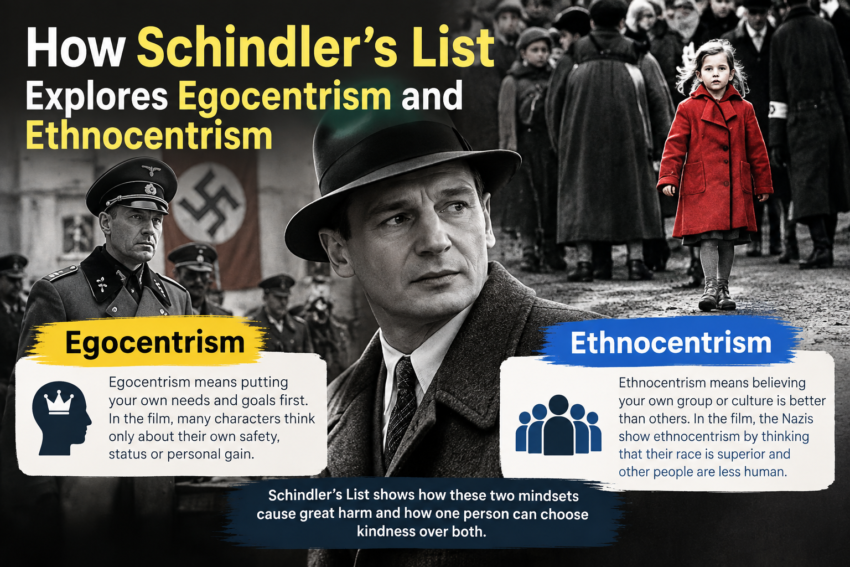
How Schindler’s List Explores Egocentrism and Ethnocentrism
Schindler’s List is a historical drama film directed by Steven Spielberg. The film is set during the Holocaust in World War II. It tells the story of Oskar Schindler and the Jewish people who suffered under Nazi rule.
The film shows many important ideas about human behavior. Two of these ideas are egocentrism and ethnocentrism. These ideas help us understand why some people think mainly about themselves or believe that their own group is better than others.
What Is Egocentrism?
Egocentrism means focusing mainly on your own needs and point of view. An egocentric person may think about personal success or personal safety before thinking about other people.
In Schindler’s List we can see this idea through some characters. Oskar Schindler is first shown as a businessman who wants to make money. He sees the war as a chance to build his business.
At the beginning he is mostly interested in his own success. He wants to become rich and powerful.
As the story continues his attitude starts to change. He begins to care more about the Jewish workers who are in danger.
Oskar Schindler and His Change
Oskar Schindler is an important example of change in the film.
At first Schindler uses the war to make money. He hires Jewish workers because they are cheap labor. His main goal is business success.
Later he sees the terrible treatment of Jewish people. He understands that the people working for him are not just workers. They are human beings who are trying to survive.
Schindler then uses his money and influence to protect many Jewish people.
This change shows how a person can move away from selfish goals and start caring about others.
What Is Ethnocentrism?
Ethnocentrism means believing that your own ethnic or cultural group is better than other groups.
This way of thinking can create unfair treatment. It can also make people see another group as less important or less human.
In Schindler’s List ethnocentrism is shown through the Nazi treatment of Jewish people.
The Nazis created a system based on racist beliefs. Jewish people were treated as an inferior group. They were removed from their homes and forced into ghettos and camps.
The film shows how dangerous these beliefs can become when they are supported by government power and violence.
Ethnocentrism in the Film
The Nazi characters show extreme examples of ethnocentric thinking.
They believe that one racial group has more value than others. This belief is used to justify discrimination and violence against Jewish people.
The film shows the results of this thinking through many painful events.
Jewish families lose their homes. People are separated from their families. Many people are killed because of their identity.
These events show that judging people only because of their group can have terrible results.
Amon Goeth and Ethnocentrism
Amon Goeth is another important character in the film. He is a Nazi officer who has power over Jewish prisoners.
His actions show how racist beliefs can become connected with power and cruelty.
Goeth treats Jewish people as if their lives have little value. His behavior shows the harmful effects of seeing one group as less human than another.
His character helps the audience understand the danger of hatred and group prejudice.
How Egocentrism and Ethnocentrism Are Different
Egocentrism and ethnocentrism are related but they are not the same.
Egocentrism focuses on the individual. It means putting your own needs and point of view first.
Ethnocentrism focuses on a group. It means believing that your own ethnic or cultural group is better than other groups.
In Schindler’s List both ideas appear in different ways.
Some characters focus on personal power and personal gain. Other characters support racist ideas about groups of people.
Schindler’s Change Shows Another Side
One of the most important parts of the film is Schindler’s change.
He starts the story as a businessman who cares about money. Over time he becomes more concerned about saving lives.
He spends his money to protect his workers. He also uses his relationships with Nazi officials to help them.
His actions show that people can change their way of thinking.
The film also shows that one person’s choices can affect the lives of many other people.
The Main Lesson of the Film
Schindler’s List teaches several important lessons about human behavior.
Egocentrism can make people focus too much on themselves. Ethnocentrism can create unfair ideas about other groups.
The film shows that these ways of thinking can lead to discrimination and suffering.
At the same time the film shows the importance of empathy and humanity.
Schindler learns to see the people around him as human beings who deserve protection.
Conclusion
Schindler’s List explores egocentrism and ethnocentrism through its characters and events.
The film shows how selfish thinking can affect personal choices. It also shows how racist beliefs can lead to discrimination and violence.
Oskar Schindler’s journey is an important part of the story. He begins by thinking mainly about business and money. Later he risks his wealth and safety to help Jewish people.
The film reminds us that our choices matter. It also shows why people should not be judged or treated badly because of their ethnic or cultural group.