
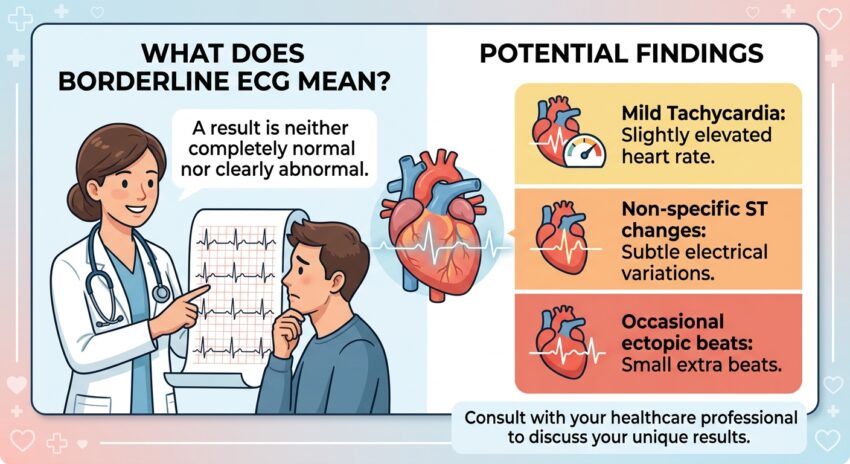
What Does Borderline ECG Mean?
If your ECG report says borderline you may feel worried about what it means. A borderline ECG result does not always mean that you have a heart problem. It usually means that the test showed a small change that is not clearly normal or abnormal.
What Is an ECG?
An ECG or electrocardiogram is a test that records the electrical activity of your heart. Small sensors are placed on your skin to measure the signals produced by each heartbeat.
The test can give doctors information about your heart rhythm and rate. It can also show certain changes in the heart’s electrical pattern.
What Does a Borderline Result Mean?
A borderline ECG means that the result has some features that are close to an unusual range. The change may be minor and may not mean that there is a serious condition.
Sometimes the result can be affected by your age or body position. The placement of the ECG sensors can also affect the reading. This is why doctors do not usually look at one report alone.
Does Borderline Mean Something Is Wrong?
Not necessarily. A borderline result does not automatically mean that you have heart disease.
Your doctor may look at your symptoms medical history and previous ECG results. They may also compare the new report with an older one. If needed they can suggest another test to get more information.
What Happens After a Borderline ECG?
The next step depends on your situation. If you have no symptoms your doctor may simply review the result and decide whether any follow-up is needed.
If you have symptoms such as chest pain shortness of breath fainting or a fast heartbeat your doctor may recommend further testing.
Final Thoughts
A borderline ECG result can have several possible explanations. It does not always mean that something is seriously wrong with your heart. A healthcare professional can explain the specific finding on your report and decide if more testing is needed.
If you are concerned about your result talk with your doctor rather than trying to understand the report on its own.