
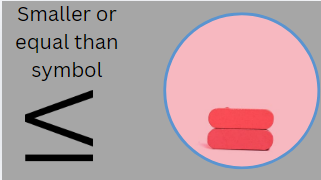
Smaller or Equal Than Symbol (≤): Meaning Uses Examples and How to Type It
Learn everything about the smaller or equal than symbol (≤) including its meaning mathematical applications keyboard shortcuts examples Unicode codes and comparison with other inequality symbols.
Smaller or Equal Than Symbol (≤)
The smaller or equal than symbol (≤) is one of the most important mathematical symbols used in mathematics science engineering programming statistics and education. It indicates that one value is either less than another value or exactly equal to it.
Whether you’re a student learning algebra a teacher creating worksheets a programmer writing conditions or a professional working with data understanding the ≤ symbol is essential.
In this comprehensive guide you’ll learn the meaning of the smaller or equal than symbol its history applications examples keyboard shortcuts Unicode values and frequently asked questions.
What Is the Smaller or Equal Than Symbol?
The smaller or equal than symbol is written as:
≤
It represents the mathematical relationship:
a ≤ b
This means:
- a is less than b or
- a is equal to b
In simple words the value on the left cannot be greater than the value on the right.
Example
5 ≤ 10
This statement is true because 5 is smaller than 10.
10 ≤ 10
This statement is also true because both values are equal.
15 ≤ 10
This statement is false because 15 is greater than 10.
Meaning of the ≤ Symbol
The symbol combines two mathematical concepts:
- Less Than (<)
- Equal To (=)
Together they create:
≤ = Less Than or Equal To
It means that a number may be smaller than another number or exactly the same.
Visual Understanding
| Expression | Meaning |
| 3 < 5 | 3 is less than 5 |
| 3 ≤ 5 | 3 is less than or equal to 5 |
| 5 ≤ 5 | 5 equals 5 |
| 7 ≤ 5 | False |
History of the Smaller or Equal Than Symbol
Mathematical notation evolved over centuries to simplify calculations and communication.
The symbols for inequalities became widely used after mathematicians sought concise ways to express numerical relationships.
The less than (<) and greater than (>) symbols were introduced by English mathematician Thomas Harriot in the 17th century.
Later mathematicians developed compound inequality symbols such as:
- ≤ (less than or equal to)
- ≥ (greater than or equal to)
These symbols became standard in mathematical textbooks and scientific publications worldwide.
Mathematical Definition
The formal mathematical definition is:
x ≤ y
if and only if:
- x is less than y or
- x equals y
This relationship is known as an inequality.
Unlike strict inequalities the ≤ symbol allows equality.
Difference Between ≤ and <
Many students confuse these two symbols.
| Symbol | Meaning |
| < | Less than |
| ≤ | Less than or equal to |
Example
Suppose the maximum age allowed is 18.
Using:
Age < 18
means only ages below 18 are allowed.
Using:
Age ≤ 18
means age 18 is also allowed.
This small difference can significantly affect mathematical solutions.
Difference Between ≤ and ≥
The symbols are related but opposite.
| Symbol | Meaning |
| ≤ | Less than or equal to |
| ≥ | Greater than or equal to |
Example
1 x ≤ 20
2 x can be 20 or smaller.
3 x ≥ 20
4 x can be 20 or larger.
Examples of Smaller or Equal Than Symbol
Basic Arithmetic Examples
Example 1
2 ≤ 5
True because 2 is smaller than 5.
Example 2
8 ≤ 8
True because both numbers are equal.
Example 3
12 ≤ 6
False because 12 is greater than 6.
Number Line Examples
Consider:
x ≤ 4
Possible values include:
- 4
- 3
- 2
- 1
- 0
- -1
- -2
and all numbers less than 4.
On a number line:
- A closed circle appears at 4.
- The shaded region extends leftward.
Smaller or Equal Than Symbol in Algebra
Algebra frequently uses inequalities.
Example
x + 3 ≤ 10
Subtract 3 from both sides:
x ≤ 7
Solutions include:
- 7
- 6
- 5
- 4
- and all smaller numbers
Quadratic Inequalities
Example:
x² ≤ 25
Solution:
-5 ≤ x ≤ 5
This means x must lie between -5 and 5 inclusive.
Use of ≤ in Geometry
Geometry often uses inequality symbols.
Example
A triangle side length may satisfy:
x ≤ 12 cm
This means the side can be:
- 12 cm
- 11 cm
- 10 cm
or any smaller valid length.
Use in Statistics
Statistics relies heavily on inequalities.
Probability Example
P(X ≤ 5)
This means the probability that variable X is less than or equal to 5.
In cumulative distribution functions (CDFs):
F(x) = P(X ≤ x)
This notation is fundamental in probability theory.
Use in Calculus
Calculus uses the smaller or equal than symbol when defining intervals and limits.
Example
0 ≤ x ≤ 10
This means x lies between 0 and 10 including both endpoints.
Use in Computer Programming
Programming languages frequently perform comparisons similar to the ≤ symbol.
Common Operators
| Language | Operator |
| Python | <= |
| Java | <= |
| JavaScript | <= |
| C++ | <= |
| C# | <= |
Example in Python
if age <= 18:
print(“Eligible”)
The condition becomes true when age is less than or equal to 18.
Smaller or Equal Than Symbol in Excel
Microsoft Excel uses:
<=
Example
=A1<=100
Returns:
- TRUE if A1 is less than or equal to 100
- FALSE otherwise
Excel formulas heavily depend on comparison operators.
Smaller or Equal Than Symbol in SQL
Database queries commonly use:
SELECT *
FROM Orders
WHERE Amount <= 500;
This retrieves records with amounts less than or equal to 500.
Smaller or Equal Than Symbol in Physics
Physics equations often include constraints.
Example
v ≤ c
Where:
- v = object velocity
- c = speed of light
The equation states that velocity cannot exceed the speed of light.
Smaller or Equal Than Symbol in Engineering
Engineers use ≤ when specifying design limits.
Example
Stress ≤ Maximum Allowable Stress
This ensures safety requirements are met.
Smaller or Equal Than Symbol in Economics
Economic models use inequalities to represent constraints.
Budget Constraint
Spending ≤ Income
This indicates spending should not exceed available income.
Smaller or Equal Than Symbol in Logic
Logical reasoning often employs inequalities.
Example:
x ≤ y
AND
y ≤ z
Then:
x ≤ z
This property is called transitivity.
Unicode and Character Information
The smaller or equal than symbol has standardized encoding.
| Property | Value |
| Symbol | ≤ |
| Unicode Name | Less-Than or Equal To |
| Unicode Number | U+2264 |
| HTML Entity | ≤ |
| HTML Decimal | ≤ |
| HTML Hex | ≤ |
These codes help display the symbol correctly on websites and software applications.
How to Type the Smaller or Equal Than Symbol
Windows
Hold:
Alt + 243
or use:
Character Map
Microsoft Word
Type:
2264
Then press:
Alt + X
Result:
≤
Mac
Press:
Option +
Depending on keyboard layout and settings.
HTML
≤
or
≤
Displays:
≤
LaTeX
\leq
or
\le
Produces:
≤
Copy and Paste Smaller or Equal Than Symbol
You can copy the symbol below:
≤
Simply highlight it and paste it wherever needed.
Common Inequality Symbols
Understanding related symbols helps avoid confusion.
| Symbol | Meaning |
| < | Less than |
| > | Greater than |
| ≤ | Less than or equal to |
| ≥ | Greater than or equal to |
| ≠ | Not equal to |
| ≈ | Approximately equal to |
| = | Equal to |
Real-Life Examples of ≤
Speed Limits
Speed ≤ 60 mph
Drivers may travel at 60 mph or below.
Weight Restrictions
Luggage Weight ≤ 23 kg
Passengers may carry bags weighing up to 23 kg.
Age Requirements
Age ≤ 12
Children aged 12 or younger qualify.
Budget Planning
Expenses ≤ Income
Helps maintain financial stability.
Why the Smaller or Equal Than Symbol Is Important
The symbol offers precision and clarity.
Without it many mathematical and scientific statements would require lengthy explanations.
Benefits include:
- Simplifies inequalities
- Improves mathematical communication
- Reduces ambiguity
- Supports logical reasoning
- Essential for programming and data analysis
- Used worldwide across academic disciplines
Common Mistakes When Using ≤
Confusing ≤ with <
Remember:
- < excludes equality
- ≤ includes equality
Reversing the Direction
Incorrect:
5 ≤ 3
Correct:
3 ≤ 5
Always verify the relationship.
Forgetting Endpoint Inclusion
For:
x ≤ 10
The value 10 is included.
Students often overlook this important detail.
Frequently Asked Questions
What does ≤ mean?
The symbol means less than or equal to. A value can be smaller than another value or exactly equal to it.
Is ≤ an inequality symbol?
Yes. It is one of the most common mathematical inequality symbols.
What is the opposite of ≤?
The opposite is:
≥
which means greater than or equal to.
What is the Unicode for ≤?
The Unicode value is:
U+2264
How do I type ≤ on a keyboard?
You can use:
- Alt codes
- Unicode shortcuts
- Character Map
- HTML entities
- LaTeX commands
depending on your device.
Is ≤ used in programming?
Yes. Most programming languages use:
<=
to represent less than or equal to comparisons.
Conclusion
The smaller or equal than symbol (≤) is a fundamental mathematical notation used to express that one value is either less than or exactly equal to another. It plays a crucial role in mathematics algebra calculus statistics programming engineering economics and scientific research.
From solving inequalities and defining ranges to writing code and creating formulas the ≤ symbol helps communicate precise relationships efficiently. Understanding its meaning usage keyboard shortcuts Unicode encoding and practical applications is essential for students professionals and anyone working with numbers or logical conditions.
Whether you’re solving equations building software analyzing data or studying mathematics mastering the smaller or equal than symbol (≤) is an important step toward greater mathematical and technical literacy.
SEO Keywords: smaller or equal than symbol less than or equal to symbol ≤ symbol meaning inequality symbol mathematical symbols less than equal sign smaller than or equal to sign how to type ≤ Unicode U+2264 inequality examples less than or equal symbol copy paste comparison operators math notation algebra inequalities programming comparison operators.