
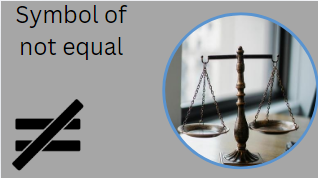
Symbol of Not Equal (≠): Meaning Uses Code and Complete Guide
Learn everything about the not equal symbol (≠) including meaning history Unicode HTML entity LaTeX code programming usage and mathematical applications in algebra and inequality. A complete SEO guide for students developers and researchers.
Introduction: What is the Not Equal Symbol?
The not equal symbol (≠) is a mathematical sign used to show that two values are not the same. It is one of the most important symbols in Mathematics and is widely used in algebra programming logic and computer science.
In simple terms:
a ≠ b means a is not equal to b
This symbol is essential in expressing inequality a core concept in Inequality and algebraic expressions.
What Does the Not Equal Symbol (≠) Mean?
The not equal sign represents a relationship where two values expressions or variables do not have the same value.
Basic Meaning:
- 5 ≠ 3 → True (5 is not equal to 3)
- x ≠ y → x is different from y
It is the opposite of the equals sign (=) which shows equality.
In Mathematics:
In Mathematics the symbol is used to define conditions where solutions are excluded or compared.
Example:
- x + 2 ≠ 10 → x is not equal to 8
History of the Not Equal Symbol
The not equal symbol has evolved over time as mathematical notation developed.
Key Historical Points:
- Early mathematicians used written phrases like is not equal to
- In the 17th–18th century symbolic algebra became standardized
- The modern ≠ symbol became widely accepted with the rise of printed mathematics
- It is now part of the Unicode Standard maintained by the Unicode Consortium
The development of symbolic notation helped simplify mathematical communication across Europe and later the world.
Unicode and Encoding of Not Equal Symbol
The not equal symbol is standardized in digital systems using Unicode.
Unicode Details:
- Symbol: ≠
- Unicode: U+2260
- Name: NOT EQUAL TO
This ensures that the symbol appears consistently across devices browsers and platforms.
Why Unicode Matters:
Without Unicode symbols like ≠ would appear differently on various systems causing confusion in math coding and scientific writing.
Not Equal Symbol in HTML
In web development the symbol can be written using HTML entities.
HTML Code:
- ≠ → ≠
- ≠ → ≠
Example in HTML:
<p>x ≠ y means x is not equal to y.</p>
This is widely used in websites educational platforms and online calculators.
Not Equal Symbol in Programming Languages
The not equal operator is extremely important in programming and logic building.
1. Python
if x != y:
print(Not equal)
2. JavaScript
if (a !== b) {
console.log(Not equal);
}
3. C / C++
if (a != b) {
printf(Not equal);
}
4. Java
if (x != y) {
System.out.println(Not equal);
}
Key Point:
Most programming languages use:
- != (not equal operator)
This is essential in decision-making logic loops and conditional statements.
Not Equal Symbol in LaTeX
In academic writing and research papers especially in mathematics and physics LaTeX is widely used.
LaTeX Code:
\neq
Example:
x \neq y
This renders as:
x ≠ y
LaTeX is widely used in scientific documentation journals and educational materials.
Not Equal Symbol on Keyboard
Unlike letters and numbers the not equal symbol is not directly available on most keyboards.
How to Type It:
Windows:
- Alt Code: Alt + 8800 (in some systems)
- Or copy and paste: ≠
Mac:
- Use Character Viewer
- Search not equal
Mobile Phones:
- Long press symbols or use emoji/symbol keyboard
- Or copy and paste from web
Copy and Paste Not Equal Symbol
Here is the symbol for easy use:
≠
You can use it in:
- Assignments
- Coding comments
- Mathematical notes
- Social media posts
Difference Between = and ≠
Understanding equality and inequality is fundamental in mathematics.
| Symbol | Meaning | Example |
| = | Equal | 2 + 2 = 4 |
| ≠ | Not equal | 2 + 2 ≠ 5 |
In algebra this distinction helps define conditions and solve equations.
Not Equal Symbol in Algebra
In algebra the not equal sign is used to represent constraints and exclusions.
Example:
- x ≠ 0 (x cannot be zero)
- y² ≠ 9 (y is not equal to ±3)
It plays a major role in solving equations in Algebra.
Not Equal Symbol in Logic and Computer Science
In logic systems and programming ≠ is used to compare values.
Applications:
- Conditional statements
- Boolean logic
- Database queries
- Search filters
Example in SQL:
SELECT * FROM users WHERE age != 18;
This retrieves all users whose age is not 18.
Not Equal Symbol in Real Life Applications
The concept of inequality is not limited to mathematics.
Examples:
- Prices of products are not equal in different stores
- Two datasets may not match in data analysis
- Weather conditions differ across regions
- Machine learning models compare values for accuracy
This makes the not equal symbol important in science engineering and economics.
Common Mistakes with Not Equal Symbol
1. Confusing ≠ with ≈
- ≠ means not equal
- ≈ means approximately equal
2. Using = instead of != in coding
This can break logic in programs.
3. Incorrect HTML encoding
Using plain text instead of ≠ in web pages can cause display issues.
Related Mathematical Symbols
The not equal symbol belongs to a group of comparison symbols:
- = Equal to
- ≠ Not equal to
- < Less than
- Greater than
- ≤ Less than or equal to
- ≥ Greater than or equal to
These are all essential in Inequality expressions.
Importance of Not Equal Symbol in Education
Students learn the not equal symbol early in mathematics because it helps build logical thinking.
Benefits:
- Improves problem-solving skills
- Builds understanding of equations
- Helps in programming logic
- Supports scientific reasoning
It is one of the first inequality symbols introduced in school-level Mathematics.
SEO Keywords for Not Equal Symbol
To improve search ranking here are important keywords:
- not equal symbol
- ≠ meaning
- not equal sign in math
- how to type not equal symbol
- not equal operator programming
- html not equal entity ≠
- latex not equal command \neq
- unicode not equal symbol U+2260
Frequently Asked Questions (FAQ)
1. What is the meaning of ≠?
It means two values are not equal.
2. How do you type not equal in HTML?
Use ≠ or ≠.
3. What is the programming version of ≠?
Most languages use !=.
4. What is the Unicode for not equal?
U+2260.
5. Is ≠ used in real life?
Yes it is used in math coding data analysis and science.
Conclusion
The not equal symbol (≠) is a fundamental part of modern mathematics and digital communication. From algebra and logic to programming and web development it plays a crucial role in expressing inequality and difference.
In Inequality and Mathematics this symbol helps define boundaries solve equations and build logical systems that power technology today.
Whether you are a student developer or researcher understanding the not equal symbol is essential for mastering mathematical and computational thinking.